Well maybe because of your assertion that renewables and nuclear are a bad combination. Renewables are notoriously unstable sources of energy and you need grid stability or you will have power outages.
This has traditionally been achieved by coal, gas and oil plants.
Nuclear power plants are a non GHG emitting way to replace this stability. Countries that have a larger share of renewables but much less nuclear than France still have to fire up their coal and gas powered plants on quiet winter nights after an overcast day. Which means more GHG emissions.
What I meant by “France is already doing just that” is that they are running their NPPs in load following mode, which means they have the ability to adjust their energy output capacity based on the share of renewable energy available.
So while I don’t know exactly why you are being downvoted (not by me in any case), it could be because you’re attacking an ally of the fight against GHG emissions. The goal is not simply to have as many solar panels or wind farms, but to reduce GHG emissions. And that’s what we have to keep in mind. So while, yes France moved to more nuclear there are more ways to look at the same news item: they are still going for 60% electrification of the nation by 2030, up from 30% right now and still going for massive expansion of renewables.
But the nuclear plants will always push the renewables away and keep the price up. It is a bad combination. You need something like gas (later hydrogen) which you can just turn on and off again. It’s just physics. Nuclear Plants will always push the price up.
That’s not necessarily true. There is less need for them if NPPs are there, sure, but the price tag is always king. If renewables are simply much cheaper they will proliferate.
And we will always have to fill in the gaps for when renewables aren’t available. Betting it all on battery tech mostly coming from China is a dangerous game in this geopolitical era.
I don’t understand why people are so anti nuclear. It doesn’t have any emissions. The US, Canada and especially Australia have massive uranium reserves. It provides grid stability. Except for being expensive there is almost nothing going against it. And life cycle costs are likely coming down substantially in the near future with emerging technologies.
Renewables + Battery is the most cheapest way. If you don’t want to import Batteries from China then you need to starz to build your own factories. Nuclear Reactors make you also depend on other countries.
I’m not directly Anti-Nuclar. I’m anti bad financial decissions. Spending so much money on Nuclear just to produce expensive electricity is just stupid. All the money needs to go to Renewables + Batteries, now.
Yes, but factories are expensive and cost a lot of time to build. So I’m not that sure about the financial picture of that either. Not to mention finding the space to put those factories + battery parks + more space for extra renewables to charge those batteries.
Nuclear also only makes Europe dependent on Canada or Australia, although Ukraine and Estonia have some too. The US has their own.
Not to mention batteries require a lot more resources. Whereas enriched uranium is only a few million tonnes per year, lithium- or sodium-ion battery technology requires resources that run in the trillions of tonnes. That’s because of the difference in energy density:
So to put this in perspective: to get the same energy that only 1 kilogram of reactor-grade uranium (at 3.5% U-235) provides, you would need sodium ion batteries with a total weight of 4.8 - 12.8 million kilograms.
Now of course batteries are reusable and nuclear fuel rods are only partly recyclable, but batteries don’t generate any energy by themselves. They need to be recharged with extra solar or wind power, on top of the ones directly feeding into the grid that you also have to build in even more factories, place onsite and individually connect to both the grid and the battery parks, etc.
This is a more rough estimate: but here they did the math:
A rough estimate suggests that about 3 million to 3.15 million solar panels may be needed to match the annual output of a large nuclear power plant
And even then you still haven’t solved what to do on all those quiet winter nights after an overcast day.
Betting it all on one horse it what’s stupid. Especially one that needs a mind boggling amount of resources. Yes we need to make batteries, but we also need to diversify and reduce dependency by expanding our nuclear power capacity.
Man you have to use Gas-fired power plant for the time being for the quiet winter nights, which is not a long time. Later you switch them to hydrogen. Problem is already solved. It’s still cheaper than nuclear plants.
In germany alone they recently discovered 43 millions tons of lithium. It’s not really a “rare” resource.
Renwables are scalable, if you need more energy you just quickly build more. Can’t say that about nuclear plants.
Building renewables is so much faster than Nuclear Plants and cheaper.
Battery prices get cheaper and cheaper every year.
Solar Panels get cheaper and more efficient every year.
If you invest now into a nuclear plant and it takes 10+ years to build. In that time renewables have evolved much more. If the Nuclear Plant is ready to produce energy, there will be already way more efficient renewable options. But you can’t just replace your nuclear plant now.
Ya’ll can be fanboying/girling to Nuclear Waterboiler Plants all you want. But it’s very clear where the future is heading.
There is still at least a decade’s worth of research to be done and then you haven’t even built or produced anything. After that we need to build production facilities for hydrogen, as well as for massive structures for pressurized storage of hydrogen. We need to alter existing plants so they can burn hydrogen. You think any of that is going to be cheap? And it may not even work as well as people think.
So yes, gas powered plants will be running for a long ass time in that scenario.
In germany alone they recently discovered 43 millions tons of lithium. It’s not really a “rare” resource. It’s not really a “rare” resource.
I used sodium-ion batteries as an example, since that is more widely available, but I can do the math with lithium-ion.
A lithium-ion battery consists of 7% lithium by weight. […] The battery’s composition also includes 7% cobalt, 4% nickel, 5% manganese, 10% copper, 15% aluminum, 16% graphite, and 36% other materials.
So we do the math again: for the equivalent of energy in one kilogram of reactor grade uranium, you need
(3,456,000 MJ * 1kg U) / (~0,7 MJ/kg * 0.07) = 345,600 kg of pure lithium
So remember, that’s equivalent to one kg of uranium. Now one NPP can hold up to 100 tonnes of uranium fuel rods. So:
345,600 kg * 100,000 = 3,456e10or ~34 billion kg
…of lithium for one nuclear power plant. So if we add your mine in Germany to the equation:
~34 billion / 43 million = 800 times
…the amount of lithium found in that mine to get the equivalent of energy that’s in a single nuclear power plant!
43 million may sound like a lot to a layperson, but it’s really not.
And then we still haven’t touched the
7% cobalt, 4% nickel, 5% manganese, 10% copper, 15% aluminum, 16% graphite, and 36% other materials.
…which are often harder to come by than lithium.
if you need more energy you just quickly build more. Can’t say that about nuclear plants.
What if you need more energy on quiet winter nights after overcast days?
Battery prices get cheaper and cheaper every year.
Production capacity is the issue. If we really want to go for worldwide storage, we can’t build anywhere near enough and they will get way more expensive really soon. Just remember what happened to memory prices recently…
In that time renewables have evolved much more.
Yeah no. Photovoltaic cells are nearing their peak efficiency. Meanwhile there is plenty of research going on about MSR’s and SMR’s that will increase nuclear efficiency and drive down the costs.
Ya’ll can be fanboying/girling to Nuclear
I actually did the math. Looks like you’re just “fan boying / girling” about non-existent storage tech, just winging it without putting any thought to it. Luckily for us, people at the top are doing their research a bit better than you did. France knows what’s up.


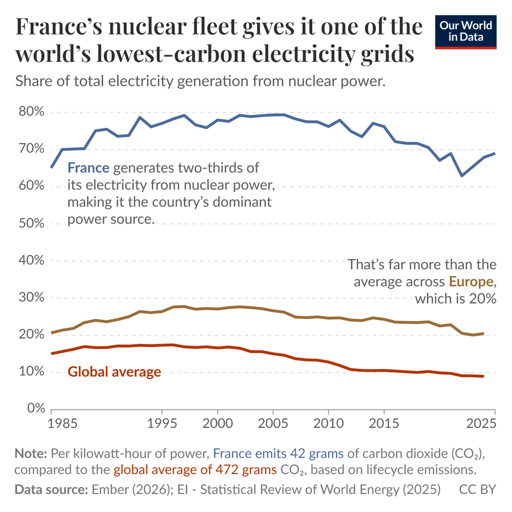
France is already doing just that
As I said, Nuclear Plants are slowing down their expansion of renewables. No idea why people downvote me.
https://www.france24.com/en/france/20260212-france-slashes-renewable-energy-targets-favour-of-nuclear-power-new-energy-law
Well maybe because of your assertion that renewables and nuclear are a bad combination. Renewables are notoriously unstable sources of energy and you need grid stability or you will have power outages.
This has traditionally been achieved by coal, gas and oil plants. Nuclear power plants are a non GHG emitting way to replace this stability. Countries that have a larger share of renewables but much less nuclear than France still have to fire up their coal and gas powered plants on quiet winter nights after an overcast day. Which means more GHG emissions.
What I meant by “France is already doing just that” is that they are running their NPPs in load following mode, which means they have the ability to adjust their energy output capacity based on the share of renewable energy available.
So while I don’t know exactly why you are being downvoted (not by me in any case), it could be because you’re attacking an ally of the fight against GHG emissions. The goal is not simply to have as many solar panels or wind farms, but to reduce GHG emissions. And that’s what we have to keep in mind. So while, yes France moved to more nuclear there are more ways to look at the same news item: they are still going for 60% electrification of the nation by 2030, up from 30% right now and still going for massive expansion of renewables.
But the nuclear plants will always push the renewables away and keep the price up. It is a bad combination. You need something like gas (later hydrogen) which you can just turn on and off again. It’s just physics. Nuclear Plants will always push the price up.
That’s not necessarily true. There is less need for them if NPPs are there, sure, but the price tag is always king. If renewables are simply much cheaper they will proliferate.
And we will always have to fill in the gaps for when renewables aren’t available. Betting it all on battery tech mostly coming from China is a dangerous game in this geopolitical era.
I don’t understand why people are so anti nuclear. It doesn’t have any emissions. The US, Canada and especially Australia have massive uranium reserves. It provides grid stability. Except for being expensive there is almost nothing going against it. And life cycle costs are likely coming down substantially in the near future with emerging technologies.
Renewables + Battery is the most cheapest way. If you don’t want to import Batteries from China then you need to starz to build your own factories. Nuclear Reactors make you also depend on other countries.
I’m not directly Anti-Nuclar. I’m anti bad financial decissions. Spending so much money on Nuclear just to produce expensive electricity is just stupid. All the money needs to go to Renewables + Batteries, now.
Yes, but factories are expensive and cost a lot of time to build. So I’m not that sure about the financial picture of that either. Not to mention finding the space to put those factories + battery parks + more space for extra renewables to charge those batteries.
Nuclear also only makes Europe dependent on Canada or Australia, although Ukraine and Estonia have some too. The US has their own.
Not to mention batteries require a lot more resources. Whereas enriched uranium is only a few million tonnes per year, lithium- or sodium-ion battery technology requires resources that run in the trillions of tonnes. That’s because of the difference in energy density:
So to put this in perspective: to get the same energy that only 1 kilogram of reactor-grade uranium (at 3.5% U-235) provides, you would need sodium ion batteries with a total weight of 4.8 - 12.8 million kilograms.
Now of course batteries are reusable and nuclear fuel rods are only partly recyclable, but batteries don’t generate any energy by themselves. They need to be recharged with extra solar or wind power, on top of the ones directly feeding into the grid that you also have to build in even more factories, place onsite and individually connect to both the grid and the battery parks, etc.
This is a more rough estimate: but here they did the math:
And even then you still haven’t solved what to do on all those quiet winter nights after an overcast day.
Betting it all on one horse it what’s stupid. Especially one that needs a mind boggling amount of resources. Yes we need to make batteries, but we also need to diversify and reduce dependency by expanding our nuclear power capacity.
Man you have to use Gas-fired power plant for the time being for the quiet winter nights, which is not a long time. Later you switch them to hydrogen. Problem is already solved. It’s still cheaper than nuclear plants.
In germany alone they recently discovered 43 millions tons of lithium. It’s not really a “rare” resource.
https://economictimes.indiatimes.com/news/international/us/43-million-tons-of-lithium-discovered-in-germany-could-transform-european-ev-battery-supply-chain/articleshow/124208076.cms
Even Texas understands that renewables + battery storage is the way to go. Besides Trump being president
https://www.cleanview.co/power-projects/planned/battery-storage-projects/texas
Renwables are scalable, if you need more energy you just quickly build more. Can’t say that about nuclear plants. Building renewables is so much faster than Nuclear Plants and cheaper.
Battery prices get cheaper and cheaper every year.
https://about.bnef.com/insights/clean-transport/lithium-ion-battery-pack-prices-fall-to-108-per-kilowatt-hour-despite-rising-metal-prices-bloombergnef/
Solar Panels get cheaper and more efficient every year.
If you invest now into a nuclear plant and it takes 10+ years to build. In that time renewables have evolved much more. If the Nuclear Plant is ready to produce energy, there will be already way more efficient renewable options. But you can’t just replace your nuclear plant now.
Ya’ll can be fanboying/girling to Nuclear Waterboiler Plants all you want. But it’s very clear where the future is heading.
I really don’t think you have any clue what you’re talking about. Do you even know where hydrogen comes from? It’s made from fossil fuels. And:
https://en.wikipedia.org/wiki/Hydrogen_production
There is still at least a decade’s worth of research to be done and then you haven’t even built or produced anything. After that we need to build production facilities for hydrogen, as well as for massive structures for pressurized storage of hydrogen. We need to alter existing plants so they can burn hydrogen. You think any of that is going to be cheap? And it may not even work as well as people think.
So yes, gas powered plants will be running for a long ass time in that scenario.
I used sodium-ion batteries as an example, since that is more widely available, but I can do the math with lithium-ion.
https://thebatterytips.com/battery-specifications/how-much-lithium-in-a-lithium-ion-battery
So we do the math again: for the equivalent of energy in one kilogram of reactor grade uranium, you need
(3,456,000 MJ * 1kg U) / (~0,7 MJ/kg * 0.07) = 345,600 kg of pure lithiumSo remember, that’s equivalent to one kg of uranium. Now one NPP can hold up to 100 tonnes of uranium fuel rods. So:
345,600 kg * 100,000 = 3,456e10 or ~34 billion kg…of lithium for one nuclear power plant. So if we add your mine in Germany to the equation:
~34 billion / 43 million = 800 times…the amount of lithium found in that mine to get the equivalent of energy that’s in a single nuclear power plant!
43 million may sound like a lot to a layperson, but it’s really not.
And then we still haven’t touched the
…which are often harder to come by than lithium.
What if you need more energy on quiet winter nights after overcast days?
Production capacity is the issue. If we really want to go for worldwide storage, we can’t build anywhere near enough and they will get way more expensive really soon. Just remember what happened to memory prices recently…
Yeah no. Photovoltaic cells are nearing their peak efficiency. Meanwhile there is plenty of research going on about MSR’s and SMR’s that will increase nuclear efficiency and drive down the costs.
I actually did the math. Looks like you’re just “fan boying / girling” about non-existent storage tech, just winging it without putting any thought to it. Luckily for us, people at the top are doing their research a bit better than you did. France knows what’s up.